
The ecosystem advantage
Traditional growth channels are losing their edge. Companies breaking through today have something structural working in their favor.


ElevenLabs crossed $330 million in annual recurring revenue last year. The company has fewer than 600 employees. That works out to roughly $570,000 in revenue per person, which puts a three-year-old AI voice startup in the same neighborhood as Google.
How? The product is excellent, but several companies make AI voice tools. The answer is something else. ElevenLabs built a Voice Library where anyone can upload a voice and earn money when it’s used. Those voices powered a wave of viral content- AI-generated presidents debating on TikTok, synthetic audiobooks, character voices in indie games. The creators earned over a million dollars in 2025. The viral content generated press, the press generated users, and many users, in turn, became creators. Somewhere in this loop, the company crossed into a category of growth that no amount of ad spend could match.
This pattern seems visible for every startup that’s growing disproportionately fast right now. Not the best product or biggest ad budget, something structural. And I think it explains a shift that most founders and growth operators haven’t fully absorbed yet.
The Great Inversion
For most of the history of technology, building the product was the hard part. The technical challenges were highly complex, and if you could actually build something that worked, that solved a genuine problem, distribution was almost a formality. You’d get noticed because there simply weren’t as many products competing for attention.
This was true for so long that it became an axiom. “Build something people want” was the advice, and distribution would follow. AI has broken this axiom quite thoroughly.
A solo founder can now ship a functional product in a weekend. Many would say “well, they’re not real products”, and many aren’t, but in this case I mean a working product with authentication, a database, a polished interface, and deployment. The kind of thing that five years ago would’ve required a crack team working for weeks or even months.
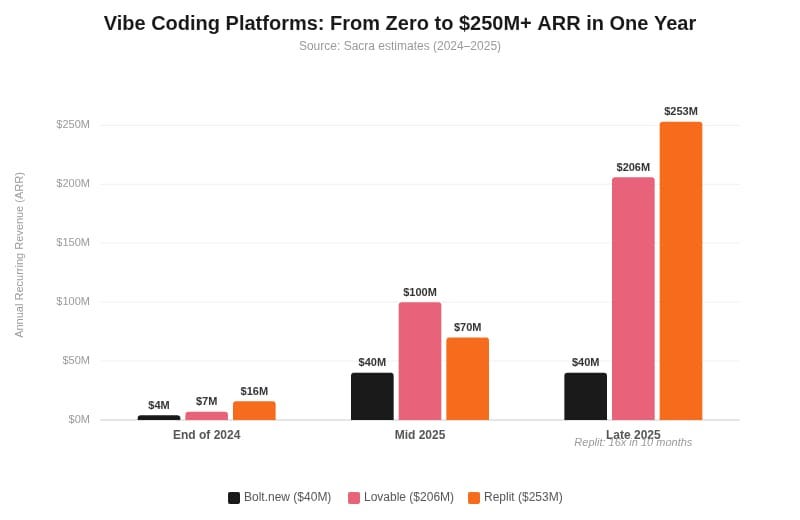
The supply of products exploded, and every channel that founders have relied on for the past decade to get those products in front of people is now degrading- all at once, and for similar reasons.
The Rising “Noise Floor”
Here is a partial inventory of what’s losing effectiveness.
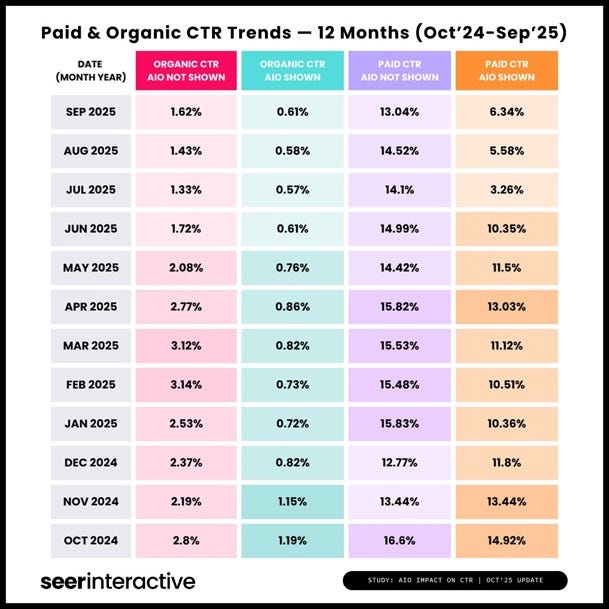
Organic search as we know it is quickly eroding. Google’s AI Overviews, which answer queries directly at the top of the results page, have driven a 61% decline in organic click-through rates since mid-2024, according to a study by the marketing firm Seer Interactive. The content marketing playbook that built an entire generation of SaaS companies (write the blog post, rank for the keyword, capture the lead) is breaking down in real time.
Outbound email is getting noisier. The same AI tools that made it trivial to build a product also made it trivial to send a cold email. AI SDRs can now generate personalized outreach at industrial scale. The result is predictable: inboxes are flooded, and average B2B cold email response rates have sunk to 3-5%. 90% of messages disappear without a reply. The channel that built SaaS (the hungry SDR with a Salesloft account and a dream) has been compromised by its own success and innovation.
Product virality is stalling. When there are ten new tools for every problem, the “try it, love it, share it” loop jams up and users struggle to distinguish signal from noise. Choice paralysis has become very real, and it’s disrupting long-established assumptions around organic adoption curves.
Events are fatigued. The post-COVID explosion of conferences, micro-summits, webinars, and LinkedIn Live sessions created a landscape in which everyone is a thought leader yet no one is listening. The conferences still happen, but the serendipitous conversations that once made them worthwhile are harder to find under the weight of sponsored content and badge-scanning.
These headwinds are all symptoms of the same underlying condition: abundance. When everyone has access to the same tools for creating products and distributing messages, the channels themselves become commoditized. The noise floor rises until it becomes much harder for any signal to break through on its own.
These channels are by no means dead, though. Direct sales still closes enterprise deals, paid acquisition still works for consumer apps with strong unit economics, and plenty of companies grow through outbound alone in markets with clear buyer intent. But for most startups trying to break through in crowded categories, these channels alone just aren’t enough.
The Trust Subsidy
So what still works?
I’ve been observing companies with the most disproportionate growth relative to their size and spend, and the pattern is remarkably consistent. Every one of them has built an ecosystem- a network of partners, creators, integrators, and communities that distribute the product without the company driving it.
Supabase capitalized on this to become the default backend for the vibe-coding era. Its open-source community created the documentation, tutorials, and YouTube walkthroughs. Integration partners like Lovable embedded Supabase as their default backend, and the community built the distribution layer that frankly no sales team could have replicated. Supabase hit $70 million in ARR last year, growing 250% year-over-year.
Clay, the GTM orchestration tool, grows almost entirely through GTM engineer “power users” (consultants, agencies, in-house operators) who create videos and tutorials showing what’s possible with the platform. What’s interesting about about Clay is that it’s extraordinarily flexible, which in the absence of an ecosystem would be a liability: too many use cases, no obvious entry point. But the creator ecosystem solved this problem by translating raw product capability into specific, legible demand.
Gamma, the AI presentation/site builder, recruited a network of micro-influencers across TikTok, Instagram, and LinkedIn, paying them per post with bonuses for virality. They catalogued successful hooks and formats to make the program scale. More than half of Gamma’s growth is now attributed to influencers. The product itself is increasingly a commodity (which feels almost shocking to say), and the ecosystem is the moat.
Lovable helps builders create apps that are naturally shareable, with “built with” badges that function like the Webflow watermarks of an earlier era. But dozens of vibe-coding tools do something similar. What separated Lovable was a Discord community that surpassed 100,000 members and a cadence of hackathons that turned users into evangelists. Elena Verna, Lovable’s head of growth, put it plainly: “The goal is no longer to produce everything in-house but to empower creators to generate content about you, and then repurpose it across paid and organic.”
The common thread is that ecosystem is not replacing channels but rather helping to unlock latent leverage within them. Some examples: a sponsored creator post becomes a “Thought Leader Ad” you can boost on LinkedIn, and the engagement on that post becomes a targeting signal for outbound follow-up; or a community conversation about your product surfaces on Reddit, and that Reddit thread gets indexed by an LLM... the new inbound.
Each channel, on its own, is seeing diminishing returns… but each channel routed through someone your audience already trusts works wonders. As Tom Orbach, the director of growth marketing at Wiz, put it: “Why start at zero when you can start at 10,000?”
The Irony
If ecosystem is becoming the biggest differentiator in growth, that’s seemingly bad news for the companies that need it most: earlier stage ventures. Large companies already have ecosystem leverage: Salesforce has a consulting and integration ecosystem that dwarfs its direct sales force, HubSpot has over 1,500 apps in its marketplace. These companies don’t need to build trust networks from scratch. For them, ecosystem is just another available lever to pull. For a startup, it’s a strategic imperative and they are starting completely from scratch.
An irony of the AI era is that the same technology that made it easy for a startup to match an incumbent’s product did nothing to help that startup match the incumbent’s ecosystem. AI can write your code, generate your content, and automate your outreach, but it can’t manufacture the trust and integration that a partner has built with your target customer over years of delivering value.
The power law in technology is steepening, and the winners have ecosystems that compound. Each new integration, creator, and community member adds a layer of distribution that makes the next layer easier to build. The rich get richer, and the startups not acting on this risk falling further behind.
The companies that do break through share a pattern that I think is underappreciated. Instead of building product first and then add ecosystem as a growth lever, they built ecosystem into the product architecture from the start. Stuff like: open source from day one, creator programs from launch, platform bets before product-market fit was proven. Arrows, a sales and onboarding tool, rebuilt its entire product exclusively for HubSpot users. The company grew nearly 40x. Its CEO, Daniel Zarick, said something that I think captures the whole dynamic: “Nobody would care about us if we didn’t try to make a mark with HubSpot first.”
Trust at Scale
I keep coming back to a broader observation that extends well beyond B2B software.
The pattern of “abundance” disrupting channels and forcing reliance on trust networks is visible across almost every domain of modern life. In media, anyone can publish, which means that curation and trusted voices have become the scarce resource. It’s no accident that Substack, a platform built on individual trust, is thriving while legacy publications struggle. In politics, anyone can broadcast a message, so insurgent media voices (podcasters, independent commentators) can become kingmakers. In commerce, anyone can sell a product, so micro-influencers on TikTok Shop are cutting through where massive ad budgets can’t.
Ecosystem-driven distribution is synonymous with delivering trust at scale. The companies that understand this will have a compounding advantage over those still relying only on channels whose returns are shrinking by the day.